Functional Behavior Assessment (FBA): How Schools Find Out Why a Behavior Happens
Every parent and teacher has asked some version of the same question: why does this keep happening? A child bolts


Every parent and teacher has asked some version of the same question: why does this keep happening? A child bolts from the classroom every day at the same time. A student melts down whenever a worksheet appears. The behavior looks random, but it rarely is.
A functional behavior assessment, or FBA, is the structured process for finding the reason. It looks at what happens before a behavior, what happens right after, and what the child gains or avoids as a result. The answer becomes the foundation for a behavior plan that works, which is why the FBA comes before nearly everything else. If you are new to how behavior plans fit with an IEP, start with our guide to ABA in the classroom and IEPs.
In behavior analysis, “function” is the purpose a behavior serves for the person doing it. Two children can do the same thing for entirely different reasons. One child hits a desk to get out of reading time. Another hits it to get a teacher to look over. The behavior looks the same. The solution is not.
The four most common functions are:
| Function | The child is trying to |
|---|---|
| Escape or avoidance | Get away from a task, demand, or social situation |
| Attention | Get a reaction or connection from adults or peers |
| Access | Get a preferred item or activity |
| Sensory | Create or stop a sensation that feels good or uncomfortable |
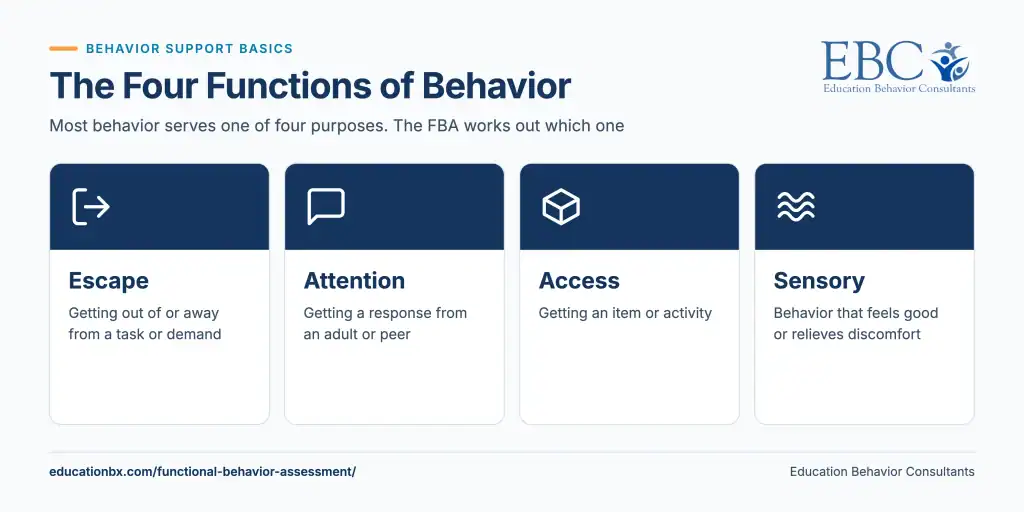
An FBA sorts out which function (or functions) is driving a specific behavior in a specific setting.
Schools use an FBA when behavior is getting in the way of learning, for the child or for classmates. According to Understood.org, that can happen as part of a special education evaluation, when a student with an IEP or 504 plan has new behavior concerns, and in certain discipline situations. The U.S. Department of Education’s November 2024 guidance goes further and says an FBA can be used for any student whose behavior interferes with learning, including students with no disability identification, and that FBAs can be used more often as an everyday instructional practice. In practice, Understood notes, FBAs are not commonly used for students who have neither an IEP nor a 504 plan, so it helps to ask your school directly.
Federal special education law (IDEA) asks IEP teams to consider positive behavioral interventions and supports when a child’s behavior impedes learning (34 CFR 300.324(a)(2)(i)). In certain discipline situations, the law goes further. When a student’s conduct is found to be a manifestation of their disability, the IEP team must either conduct an FBA and implement a behavior intervention plan, or review and modify an existing plan (34 CFR 300.530(f)). A student removed from their placement for conduct reasons must also receive, as appropriate, an FBA and behavioral intervention services intended to keep the behavior from recurring (34 CFR 300.530(d)).
An FBA is not reserved for those moments. Many teams consider one earlier, when a pattern first appears. Earlier is usually better, because patterns that have been happening for months are harder to change than ones that began last week.
Neither federal nor California law defines what an FBA must include, according to the California Department of Education, so the process varies from district to district.
Different districts and clinicians use different forms, but the process follows the same logic.
The team writes down the concern in observable terms. “Acts out” becomes “yells and throws materials during transitions between activities, usually two or three times a day.”
This is often remembered by the acronym RIOT:
Direct observation usually includes ABC data. The observer records the Antecedent (what happened just before), the Behavior (what the child did), and the Consequence (what happened right after). After enough observations, patterns appear.
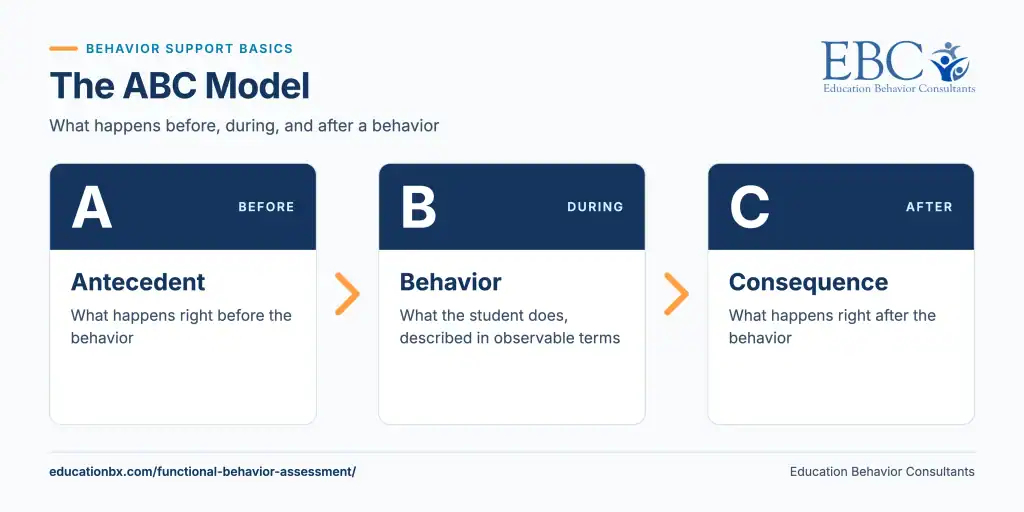
Where does the behavior happen? When? With whom? What tasks come right before it? What does it get the child? Does it stop at certain times of the day or in certain settings? These patterns point toward the function.
The team states the best explanation in one sentence. For example: “When given independent writing tasks longer than ten minutes, the student tears paper to escape the task.”
The hypothesis becomes a behavior intervention plan. It describes how to change the setting, teach a replacement skill, and respond consistently. Our guide to behavior intervention plans shows what those plans contain.
After the plan starts, the team tracks whether the behavior is changing and revises as needed. If the data does not move, the hypothesis may need another look.
Practitioners commonly describe three levels of functional assessment, matched to how complex the behavior is:
Ask your school which approach it plans to use and why.
Understood describes a school team led by someone trained in behavior, such as a school psychologist or behavior specialist. Teachers, staff, service providers, the student, and the family may all take part. A Board Certified Behavior Analyst (BCBA) may lead or contribute, and some districts bring in an outside behavior specialist for support. What matters is that the person has training in behavior assessment and that the team includes people who know the child well.
If your child’s behavior is interfering with learning, you can ask the school to consider an FBA. Understood and Disability Rights California both advise putting the request in writing, addressed to your child’s IEP team or the school administration. A few practical suggestions:
Rules and timelines differ by district, and students with an IEP have additional protections. If you hit roadblocks, a special education advocate or attorney can help. Disability Rights California’s special education manual is a free place to start.
These notes speed up the assessment and make the final plan more practical.
Families sometimes worry an FBA means their child is being labeled. A well-run FBA does the reverse. It treats behavior as communication and looks for what the child needs. You should hear questions about the environment, the task, and the supports around the child as often as you hear questions about the child.
Signs of a strong process:
A functional behavior assessment is a structured process for finding out why a behavior is happening by looking at what comes before it, what follows it, and what the child gets or avoids as a result.
Teams define the behavior, gather information through records, interviews, and observation, look for patterns, write a hypothesis about the function, build a behavior intervention plan, and monitor the data.
The FBA is the assessment that identifies the reason for the behavior. The BIP is the plan, based on the FBA, that describes how the team will prevent the behavior and teach a replacement skill.
A school team led by someone trained in behavior, such as a school psychologist or behavior specialist, usually conducts it, with input from teachers, the family, and sometimes a BCBA. The key is training in behavior assessment and input from people who know the child.
Yes. Parents can ask the school in writing, addressed to the IEP team or school administration, to consider an FBA when behavior interferes with learning. California guidance says parental consent is required before an FBA is conducted. Procedures and timelines vary by district.
The four most commonly described functions are escape or avoidance, attention, access to something the child wants, and sensory needs.
Not necessarily. Federal guidance says an FBA can be used for any student whose behavior interferes with learning. In practice, schools most often use formal FBAs for students with an IEP or a 504 plan, and students with an IEP have additional legal protections. Ask your school how it handles requests for students without one.
EducationBX supports schools and families across the Bay Area, Clovis, North San Diego, and the Central Coast. Schools can learn about our student behavior support, which includes functional behavior assessments and behavior intervention plans delivered by BCBAs and RBTs, and our classroom consultation. Families can explore our family support services or contact our team. A school’s own FBA is led by the school team; we support schools and families alongside that process.