Functional Behavior Assessment (FBA): How Schools Find Out Why a Behavior Happens
Every parent and teacher has asked some version of the same question: why does this keep happening? A child bolts

When a child’s behavior keeps getting in the way of learning, the school day can turn into a string of phone calls, notes home, and meetings. A behavior intervention plan, usually shortened to BIP, is the document that turns that frustration into a concrete plan everyone can follow.
A BIP is a written plan that describes a specific behavior, explains why the child is doing it, and lays out what adults will change and what new skill the child will be taught instead. It is built from information, not guesses. The goal is not to make a child “behave.” The goal is to help the child get what they need in a way that works for them and for the people around them.
Below is a plain-language look at what goes into a BIP, who writes it, how it fits with an IEP, and how to tell whether it is working.
Most challenging behavior has a job. A child who throws a worksheet may be avoiding work that feels too hard. A child who calls out constantly may be looking for adult attention. A BIP names that job and then does three things:
This is why a BIP differs from a list of consequences. Punishment may stop a behavior for a day. A BIP addresses why the behavior shows up in the first place.
A BIP should be built on a functional behavior assessment (FBA). The FBA comes first and is the information-gathering step. A trained professional observes the child, reviews records, and interviews teachers and parents to work out what the behavior accomplishes for the child. Our guide to functional behavior assessments explains that process in detail.
The BIP is what comes next. If the FBA answers “why is this happening?”, the BIP answers “so what are we going to do about it?”
According to the IRIS Center at Vanderbilt University, a behavior intervention plan includes:
IRIS describes BIPs as the tool for students whose behaviors are severe or chronic and interrupt instruction. Milder concerns are often handled with simpler classroom supports first.
Good plans describe behavior in terms anyone could observe. “Is disrespectful” is a judgment. “Leaves seat and walks to the door during independent work, about three times per 30-minute block” is a behavior. Clear descriptions keep every adult measuring the same thing.
Behavior analysts group the reasons for behavior into a few categories:
| Function | What it looks like |
|---|---|
| Escape or avoidance | The child tries to get out of a task, a demand, or a social situation |
| Attention | The child seeks a reaction from adults or peers |
| Access to something | The child wants an item or activity |
| Sensory | The behavior feels good or relieves discomfort on its own |
The same behavior can have different functions in different children. Yelling during math may be escape for one student and attention for another. That is why the same strategy can work beautifully for one child and fail for the next.
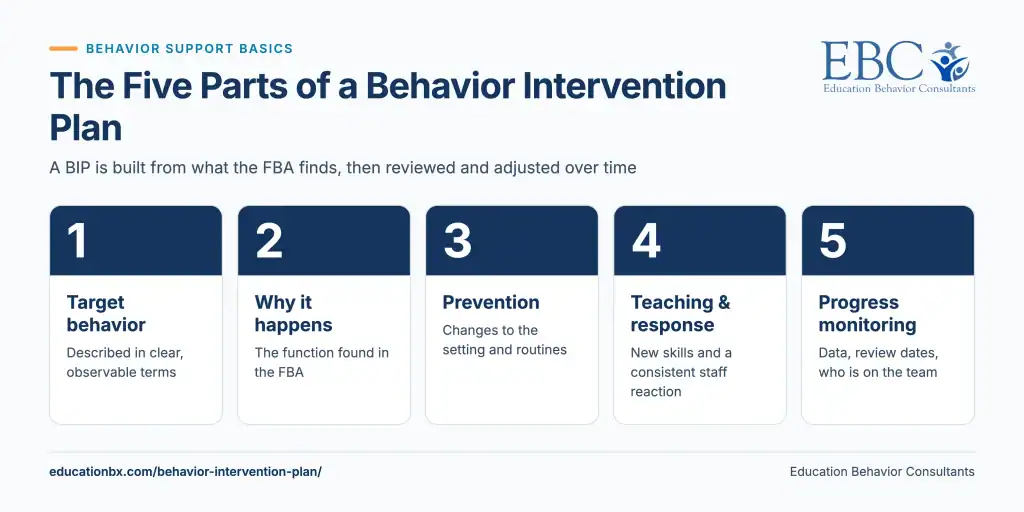
These change the setting so the behavior is less likely. For a student who escapes hard writing tasks, that could mean breaking the assignment into smaller chunks, offering a choice of how to respond, or pairing a difficult task with an easier one first.
The child needs a better way to get the same result. If the behavior is escape, the replacement might be asking for a break with a card, a gesture, or a phrase. If the behavior is attention-seeking, it might be raising a hand or tapping a teacher’s desk card. Replacement skills only work when the adult responds to them quickly and consistently, especially at first.
This section tells every adult what to do when the behavior happens and when the replacement skill appears. When teachers, aides, and parents respond the same way, the child learns the new rules quickly. When responses vary, the old behavior sometimes still works, and it comes back stronger.
Here is how one plan might read for a second grader. This is an illustration, not a template for any real child.
Notice that the plan does not ask the child to “just try harder.” It rebuilds the task and teaches a skill the child did not have.
A BIP is a team product. IRIS says it should be developed collaboratively by educators, the student and their family, and other relevant professionals. Depending on the child, the team may include parents or caregivers, the classroom teacher, a special education teacher, a school psychologist, and a behavior specialist or Board Certified Behavior Analyst (BCBA). Parents bring something no one else has: knowledge of what works at home and a long view of the child’s history.
Under the federal special education law, the Individuals with Disabilities Education Act (IDEA), IEP teams must consider positive behavioral interventions and supports for a child whose behavior impedes their own learning or the learning of others (34 CFR 300.324(a)(2)(i)). A BIP is one of the most common ways teams do that.
Often, yes. The California Department of Education’s guidance for school districts says that if an IEP team decides a BIP is appropriate, it must be included in the IEP. Our guide to ABA in the classroom and IEPs shows where behavior plans fit among the other documents a school may use.
Not every behavior plan is tied to an IEP. The U.S. Department of Education’s 2024 guidance says FBAs and behavior support plans can be used for any student whose behavior interferes with learning, and that IDEA itself requires a BIP only in certain discipline cases. Some schools use plans for students with a 504 plan, or through school-wide tiered supports, where the formal FBA-and-BIP process is typically reserved for students with the most intensive needs. Rules and terminology vary by district, so the best move is to ask the school how it handles behavior plans for your child.
Federal rules do require functional assessment and behavior planning in specific discipline situations. If a student’s conduct is found to be a manifestation of their disability, the IEP team must conduct an FBA and implement a BIP, or review and modify an existing BIP (34 CFR 300.530(f)). Families who are in that situation may want to consult a special education advocate or attorney. Disability Rights California publishes a free special education manual that explains these rights.
A good plan produces visible change within a few weeks. Look for:
If the numbers are not moving, ask the team to review the plan. The function may have been misread, the replacement skill may be too hard, or the plan may not be carried out the same way by every adult. Plans are meant to change as the child changes.
A behavior intervention plan is a written plan that identifies a specific behavior, the reason it is happening, the strategies adults will use to prevent it, and the replacement skills the child will be taught.
The FBA is the assessment that finds out why a behavior is happening. The BIP is the action plan built from those findings.
Sometimes. Schools may use behavior plans for students with a 504 plan or through school-wide tiered supports, but the formal FBA-and-BIP process is most often tied to an IEP. When an IEP team decides a BIP is appropriate in California, it must be included in the IEP. Ask your school how it handles this.
A team creates it, often including parents, the student, teachers, a special education teacher, a school psychologist, and a behavior specialist or BCBA.
A BIP stays in place as long as the child needs it. Teams review it regularly and change it as the child learns new skills or circumstances shift.
An effective plan rests on a thorough assessment, describes behavior in observable terms, teaches a replacement skill, is carried out consistently by every adult, and includes a progress monitoring plan so it can be reviewed using data.
A well-designed BIP focuses on prevention, teaching, and reinforcing positive behavior. It does not rely on punishment as its main tool.
EducationBX supports schools and families across the Bay Area, Clovis, North San Diego, and the Central Coast. Schools can learn about our student behavior support and classroom consultation services, where our BCBAs and RBTs help develop practical behavior plans and coach staff to carry them out. Families can explore our family support services or contact our team with questions.